Levels of participation (SEND co-production)

Levels of participation (SEND co-production)

Find out about different ways people can be involved, when co-production is not always possible.

In Worcestershire we recognise that there are different ways people can be involved as co-production may not always be possible.

We use the flower of participation to visually show the different levels of participation.
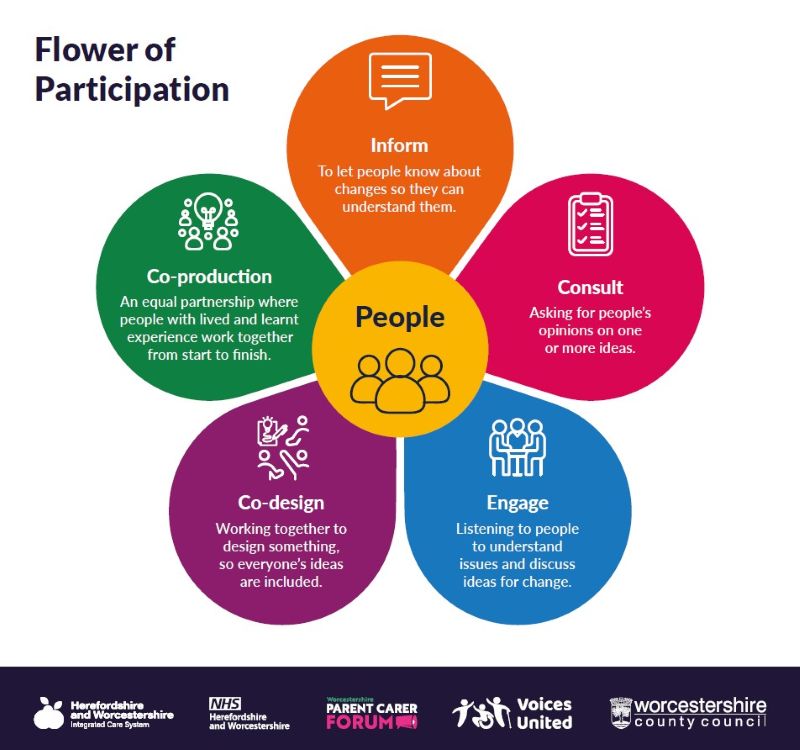
 

Download: Flower of Participation (PDF)

Here is a breakdown of the different levels and what this may look like in practice.

Inform

This may look like:

  • keeping webpages updated
  • bulletins and leaflets
  • assemblies in schools
  • sharing information with other organisations

Consult

This may look like:

  • emailing a questionnaire with closed questions e.g. yes or no, agree or disagree 
  • meetings with individuals 
  • creating a focus group to answer questions only

Engage

This may look like:

  • creating a focus group to discuss issues in certain areas
  • workshops to gather opinions with open ended questions
  • open ended questions in questionnaires about opinions of a service

Co-design

This may look like:

  • designing a physical space e.g. a sensory room
  • designing documents like policies and paperwork 

Co-production

This may look like: 

  • an equal partnership, no power imbalances 
  • creating a forum within a service 
  • have children and parent carers on strategy boards with decision makers
  • creating a working group of participants to come up with ideas and work through the project from start to finish

Individual, operational and strategic levels of participation

You may find that within the levels of participation, people may participate at different levels; individually, at a service or operational level, or at a strategic level. Find out more below.

Individual participation

This is about being part of a decision or process that is about an individual. It may affect an individual’s support and care. It may relate to everyday activities. It may affect their life, and what they want from it.

Examples include:

  • young people being part of hiring their own personal assistant 
  • being part of reviews for an education, health and care plan (EHCP)
  • choosing what to do as part of a short break

Service or operational participation

This is about being part of something that affects an individual and others who attend a service now and in the future. It may impact the day to day running of an organisation.  It might be able the planning, delivery, evaluation of services. It might be trying to improve quality of services.

Examples include:

  • young people giving ideas for a youth group session planning what games they would like there
  • young people interviewing somebody who is applying to work at the school

Strategic participation

This is about being involved in decisions that influence policy (the rules that tell us how to do something), practice (how we actually do something) and commissioning (what we spend money on).

It needs the people who can make decisions and the individuals to work together.

Examples include:

  • people sharing their views on short breaks provision which will influence and inform where the budget (money) goes
  • development of a strategy or policy that will impact people and families 
Was this page useful?